
Latex in fashion and haute couture: a material that is redefining contemporary fashion

A demanding material, a rare craft, a new way of inhabiting the body
Latex is not meant to please everyone.
It attracts, it intrigues, it sometimes unsettles. And that is precisely why, over the years, it has become a key material in contemporary fashion and haute couture.
Long confined to a reductive interpretation, latex is now being reclaimed by designers, studios, and artisans who work with it for what it truly is:
a technical, living, sculptural material that demands precision, experience, and deep respect for the body.
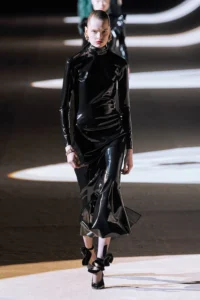
Latex: a material that does not lie
Unlike traditional textiles, latex hides nothing.
It does not float, it does not blur volumes. Instead, it smooths the silhouette and brings the body into focus exactly as it is.
This direct relationship with reality is what gives latex its strength.
A well-designed latex garment becomes a second skin, able to:
-
follow movement,
-
capture light,
-
reveal presence.
But this visual power only exists when the cut is right. Without mastery, latex becomes uncomfortable, stiff, even caricatural. When expertly crafted, it is fluid, elegant, and surprisingly comfortable.
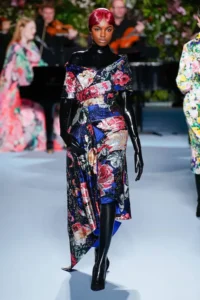
From the margins to couture legitimacy
For years, latex was confined to an underground aesthetic.
Then a handful of designers changed the narrative by integrating it into a structured fashion language.
-
Thierry Mugler used it as a modern, powerful, symbolic armor.
-
Vivienne Westwood turned it into a political tool—provocative, yet deliberate.
-
Atsuko Kudo demonstrated that a latex garment could belong to the most precise realm of couture.
This work opened the door to a new understanding: latex is not a costume.
It is a stylistic language.
What haute couture understood about latex
In haute couture ateliers, latex is no longer a curiosity.
It is used for what it enables: structure, tension, immediate visual impact.
At houses such as Balmain, Mugler, or Saint Laurent, it dialogues with leather, tulle, or vinyl. Cuts are sharp, architectural, designed for movement.
Latex does not replace other materials.
It adds a dimension.
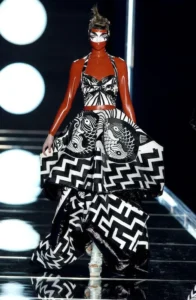
An inherently artisanal material
This is often overlooked: latex is one of the most artisanal materials in fashion.
-
it is not sewn, it is bonded,
-
each piece is cut by hand,
-
every finish is visible.
Creating a latex garment requires time, precision, and an intimate understanding of the body.
It is atelier work—almost goldsmith-like—where technique is entirely at the service of aesthetics.
This level of demand explains why well-made latex pieces are most often produced in small runs or made to measure, far from industrial logic.
From the runway to real life: wearable latex
Today, latex is gradually leaving the runway to enter a more everyday wardrobe.
Brands such as Avellano or House of Harlot have shown that it is possible to create:
-
wearable pieces,
-
clean, understated cuts,
-
garments that integrate seamlessly into a personal style.
The key is not to “do fetish,” but to think of the garment as a garment, with the same standards as any high-end fashion piece.
Real bodies, real shapes
Latex is not elitist by nature.
It only becomes so when it is poorly designed.
When well crafted, it adapts to:
-
slim or curvy bodies,
-
masculine or feminine silhouettes,
-
atypical morphologies.
Made-to-measure and thoughtful adaptation are essential tools here.
They are what allow latex to become inclusive, comfortable, and empowering—far removed from the rigid standards of traditional fashion.
Latex as an aesthetic and personal choice
Wearing latex is not a gratuitous provocation.
It is an aesthetic choice, often a considered one, that says something about the relationship to the body, to style, and to image.
This is also why latex has become such a strong symbol in contemporary visual culture: it allows people to reclaim control over how they present themselves.
Conclusion: a material that deserves to be understood
Latex is neither a passing trend nor a simple visual effect.
It is a demanding, honest material that rewards craftsmanship done right.
When designed with seriousness, within an artisanal and body-respectful approach, it becomes a powerful, durable, and deeply modern garment.
It is within this balance—between craftsmanship, elegance, and freedom—that latex finds its full legitimacy today.